
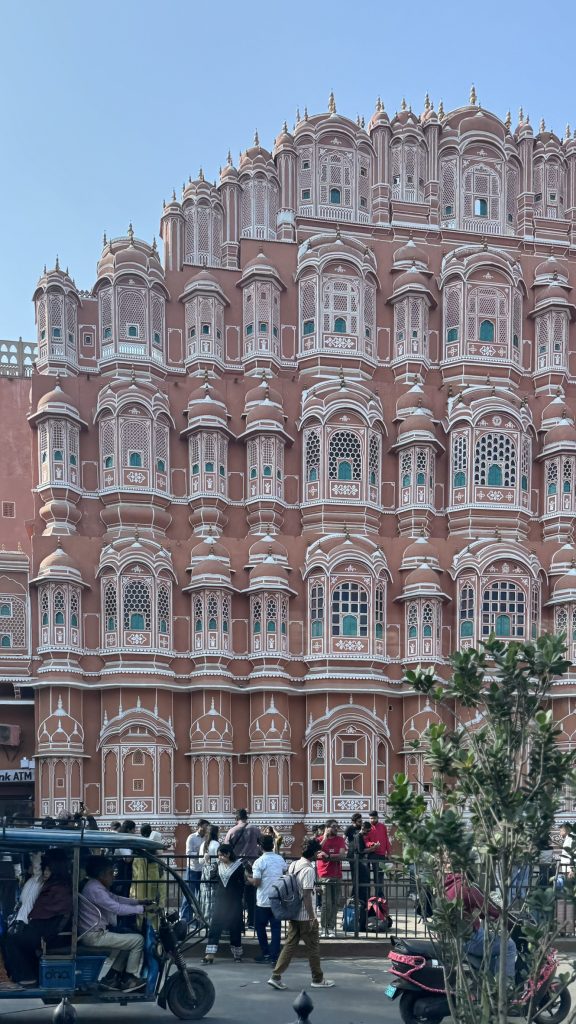
I’m only just settling back into home life after the most inspiring trip to Northern India – Jaipur and Bagru – the kind of journey that stays with you long after the dust has washed out of your clothes and the last of the marigold petals have fallen out of your bag. And are now hung in garlands outside my front door here in London.
This was my first trip to India. I travelled there knowing only Yolande, the yoga instructor who was leading this two week retreat with Alice, block print specialist from OM Baby, and I came home feeling as though I’d gathered a whole new circle of people I’m looking forward to seeing again. We’ve already made loose plans to reunite in Ballycastle, where Ciara has the wonderful Ursa Minor Bakehouse.
Staying at the artist’s garden
We were based in a beautiful house known as the artist’s garden – the sort of place where time slows down. Courtyards, birdsong, white-washed walls, and a pool that felt like the biggest treat after warm days out exploring. I shared a room with Emma, again, who I’d never met before, and we fell into a lovely travel-friendship instantly – the kind of easy connection that makes a trip feel even more special.
The gardens were a lovely place for a bit of reading, relaxing early evening with the group of 12 of us, and I even took my incredibusy salvaged speed loom with me to do a bit of repair work on a friend’s Tshirt.
Three days of learning in Bagru
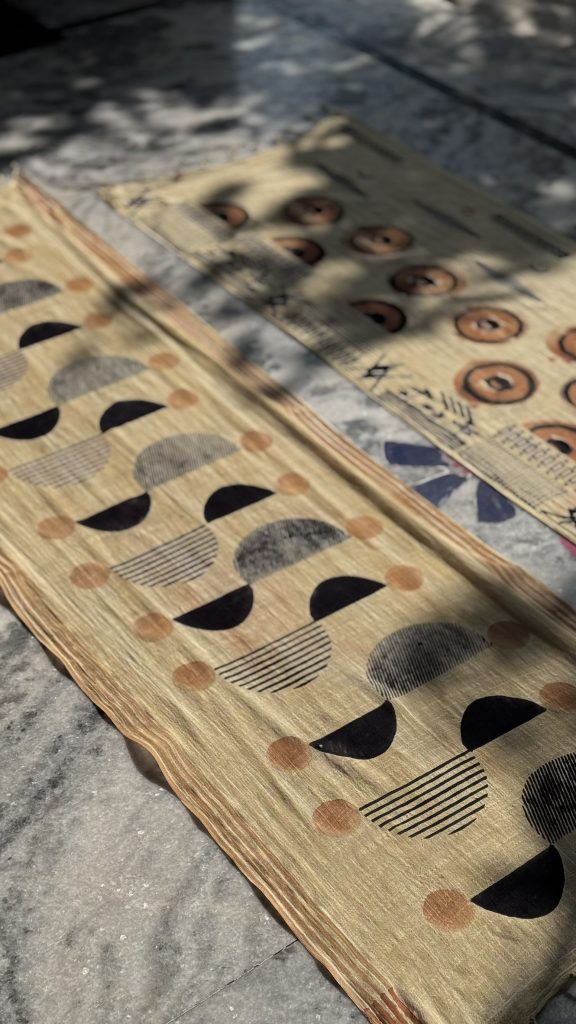
Bagru was the true heart of the journey. We spent three full days there learning traditional block printing and natural dyeing, guided by Alice of Om Baby, whose fabrics are printed in the village. Bagru Textiles’ Vijendra Chhipa has this calm, grounded way of explaining techniques while letting you explore and experiment. It was such a privilege to learn directly from craftspeople who’ve inherited these skills through generations. And the family made us all the most beautiful lunches, we sat crosslegged on the floor and enjoyed!
The slow rhythm of the workshops – stirring dye vats, drying fabrics in the sun, pressing blocks into cloth with steady hands – felt meditative. And seeing the artisans’ mastery made me appreciate every printed textile I own in a whole new way.
Yoga, chai, flower markets
Mornings began with Yolande’s gentle yoga practice on the roof, watching the sunrise, such a grounding start to each day. And early evening in the garden on alternate days. Really enjoyable yoga sessions – thank you Yolande.
From there we wandered through the Jaipur flower market, which is honestly one of the most vivid experiences I’ve ever had. Garlands of marigolds, rose petals everywhere, vendors chatting, stringing flowers into garlands that add such amazing colour to Jaipur.
Chai breaks became a daily ritual, always in small clay cups that warmed your hands. And the food! Delicious, fresh, comforting, everything I love about Indian cooking.
Pushkar treasures (and a very lively head massage)
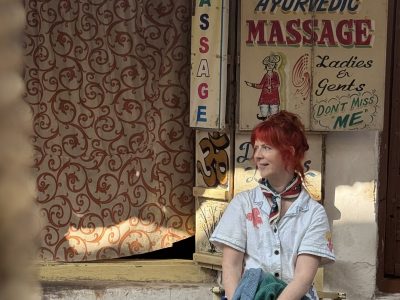
Our trip to Pushkar Lake brought a welcome moment of calm – followed immediately by the most enthusiastic head massage imaginable. The sort that leaves you blinking, slightly dazed, and absolutely wide awake and slightly wondering what had just happened, so glad that Yolande was there with me to record it – mad.
Pushkar was also where we stocked up on bits for my visible mending workshops. I found beautiful sharp little scissors and a handful of textile odds and ends from the street markets. My family’s Christmas Stockings will be benefitting from these treasures. Sssssh.
A jacket with history
Somewhere along the way I fell in love with a jacket made from a vintage kantha quilt. Hand-stitched, soft with age, and completely unique. It already feels like an old friend, and has had loads of compliments, as predicted by Yolande who found it amongst the treasures at Anthropology.
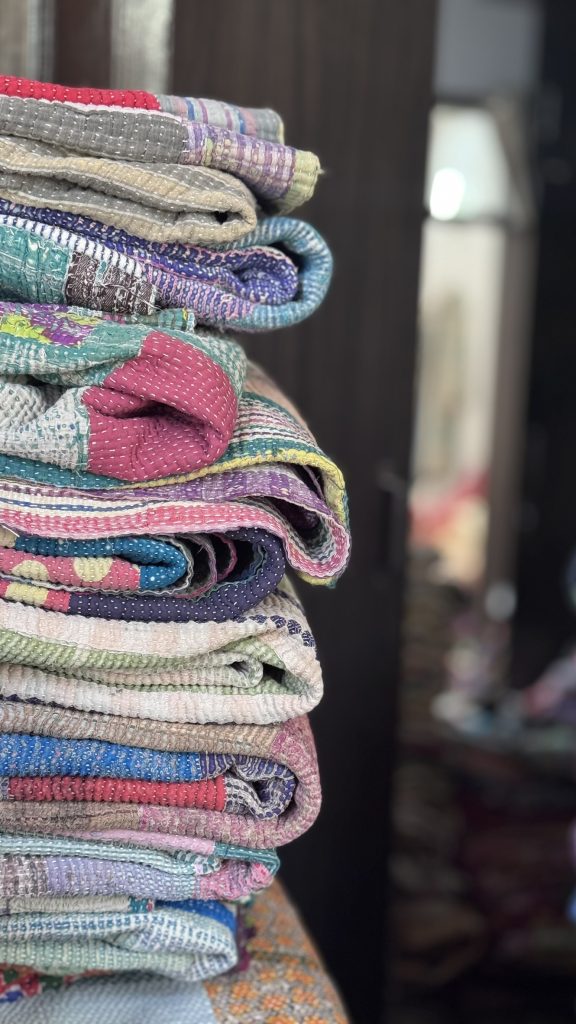
Kantha blankets are made by layering worn saris or soft old cottons and stitching them together with simple running stitches. It’s a beautiful example of reuse, giving tired fabrics a new life through hundreds of tiny hand-stitches. The finished cloth has this gentle, rippled texture, and feels so nice to the touch. No two kantha pieces are ever the same, and that’s what I love about them. They carry a sense of history, care and quiet creativity, which makes anything made from them – like the jacket I brought home – feel especially treasured.
The stepwell and the Taj Mahal
The stepwell at Devisinghpura was breathtaking. All quiet symmetry and pale stone, a geometric dream. Stepwells, or baoris, are ancient water systems found across northern and western India. Instead of a simple well, they’re deep, beautifully engineered structures that you reach by walking down long, geometric staircases as the water level changes with the seasons.
The stepwell at Devisinghpura isn’t used for water any more, but standing there in the quiet, with its perfect geometry and soft echoing spaces, you can still feel its history. It’s like the memory of its purpose is held in the stones.
And the Taj Mahal, which we saw in Agra at the end of the trip, was every bit as moving as people say. No photograph prepares you for the softness of the stone or the way it seems to glow from within.
What I’m bringing home
More than the block prints we made or the textiles tucked into my suitcase, I’m bringing home the feeling of being part of a small creative community for that short, glowing week. The kindness, the conversations, the shared meals, the laughter.
India has woven itself into me. And I can’t wait to return, maybe on a bike trip across the south next time?!
____________________________________
Follow Yolande here: www.instagram.com/yolandejeevikadiver
Visit Alice’s website here: om-baby.co.uk and follow her on instagram here: www.instagram.com/ombaby_
 The Integra Baby Carrier Harris Tweed Edition: Handmade in Somerset, UK
Leave a Reply